







Welcome to our curated and vetted list of facial recognition statistics.
Let’s make a start:
Top Facial Recognition Statistics
- There’s less than a one-in-a-million chance that someone could unlock your iPhone or iPad with Face ID.
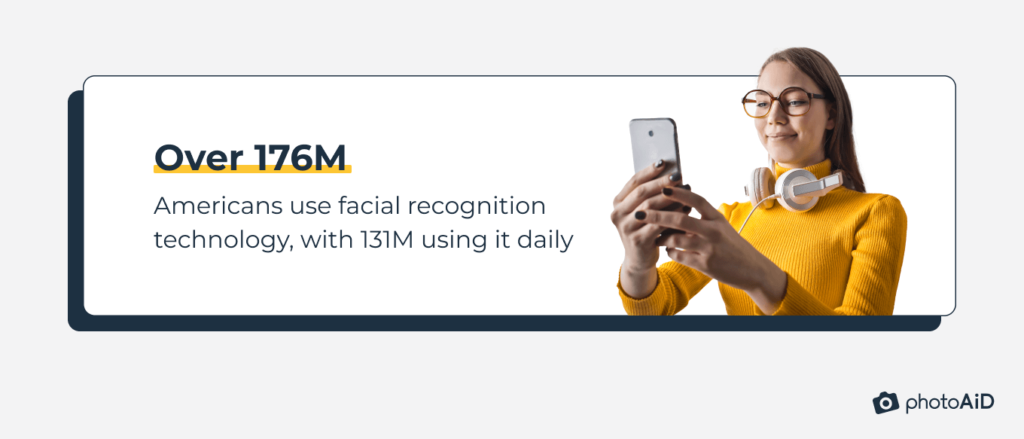
- Over 176M Americans use facial recognition technology (FRT), with 131M using it daily.
- Seven in 10 governments use facial recognition extensively.
- The accuracy of facial recognition technology is at least 99.5%.
- The facial recognition market revenue is expected to reach $19.3B by 2032.
- CBP (Customs and Border Protection) has used biometric facial comparison technology to screen over 193M travelers.
Facial Recognition Technology Usage and Market Growth
01. The facial recognition market revenue is expected to reach $19.3B by 2032.
| Global Facial Recognition Market Revenue: 2019–2032 | In Billion USD |
| 2019 | 4.35 |
| 2020 | 3.60 |
| 2021 | 5.01 |
| 2022 | 5.50 |
| 2032* | 19.30 |
02. Over 176M Americans use facial recognition technology, with 131M using it daily.
03. Unlocking phones, laptops, and personal computers (68%) is the most common use of facial recognition.
| Key Applications of FRT | In % |
| Unlocking a phone, laptop, or another personal computer | 68 |
| Logging in to an app on a phone, such as a healthcare portal or ticketing app | 51 |
| Accessing a bank account or another financial institution | 42 |
04. There’s less than a one-in-a-million chance that someone could unlock your iPhone or iPad with Face ID.
05. The accuracy of facial recognition technology is at least 99.5%.
06. Facial recognition on shared equipment, such as in gyms, is used by 12% of people aged 18–34, 6% aged 35–54, and 1% over 55.
07. Some 15% of those aged 18–34 use facial recognition for work access and clocking in/out, vs. 9% in the 35–54 age group and 3% in the 55+ group.
08. The majority of experts predict facial recognition (45%) to lead in usage growth, followed by multimodal at 16%.
| Biometric Technology Anticipated to Experience the Most Significant Increase in Use | In % |
| Face | 45 |
| Multimodal | 16 |
| Voice | 9 |
| Iris | 7 |
| Behavioural | 6 |
Sources: Apple, Biometrics Institute, FaceMe, Market.us, NIST
Facial Recognition Acceptance
09. Americans show the greatest acceptance of facial recognition for increased safety in airports (55%), banks (54%), and medical offices (53%).
| Places Where Americans Are Most Open to the Use of FRT for Enhanced Safety | In % |
| Airports | 55 |
| Banks | 54 |
| Medical offices | 53 |
| Offices | 39 |
| Hotels | 30 |
| Sports stadiums | 29 |
| Public transportation | 28 |
| Retail and grocery stores | 26 |
| Restaurants | 23 |
10. A large majority of Americans (81%) approve of using facial recognition for passport control.
| Acceptance of FRT in the United States by Case | In % |
| Passport control | 81 |
| Building access | 72 |
| Police surveillance | 55 |
| Retail purchase | 49 |
| Emotion analysis | 42 |
| Personalized advertising | 40 |
11. Nearly half of US adults (46%) support the widespread use of facial recognition by police, considering it good for society.
12. About 80% of Americans report at least some awareness of police using facial recognition technology.
13. A majority (57%) think US crime levels would stay similar if police broadly adopted facial recognition technology.
14. Roughly 78% believe facial recognition tech would likely increase police efficiency in finding missing persons and solving crimes (74%).
| Americans’ Beliefs on Outcomes of the Widespread Use of FRT by Police | In % |
| Find more missing persons | 78 |
| Solve crimes more quickly and efficiently | 74 |
| Be able to track everyone’s location at all times | 69 |
| Use the technology to monitor Black and Hispanic neighborhoods much more often than other neighborhoods | 66 |
| Make more false arrests | 53 |
| Be better able to keep crowds under control | 49 |
15. About 34% of Americans believe facial recognition use by police will improve fairness in policing.
16. Around six in 10 adults agree that police scanning crowds at concerts (63%) and public protests (61%) with facial recognition is acceptable.
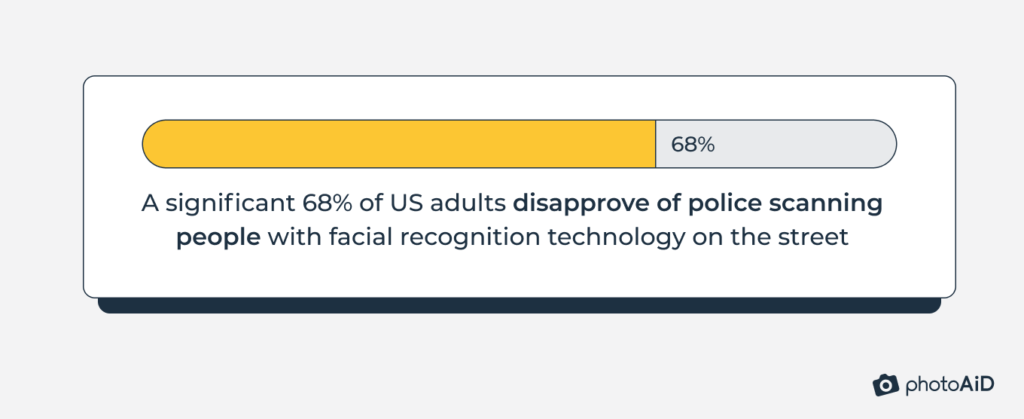
17. A significant 68% of US adults disapprove of police scanning people with facial recognition technology on the street.
18. Two-thirds (64%) of US citizens agree that police officers’ use of FRT would be more acceptable if they were trained to understand how it can sometimes misidentify people.
19. Over half of Americans (53%) would accept facial recognition use if informed in advance about the public events and spots where it was to be used.
20. Roughly 45% of Americans think police use of FRT would be more acceptable if people without criminal records could choose not to be included in facial recognition databases.
21. About 53% of US adults support facial recognition use for security, like verifying credit card users in retail stores.
| Uses of FRT in Various Scenarios US Adults Favor | In % |
| Retail stores enhancing credit card payment security by confirming account holders at checkout | 53 |
| Apartment buildings tracking who enters or leaves their buildings | 51 |
| Companies automatically tracking the attendance of their employees | 30 |
| Social media sites automatically identifying people in photos | 19 |
22. Six in 10 adults are somewhat aware of employers using facial recognition technology.
23. Seven in 10 adults in the US disapprove of companies using facial recognition to assess workers’ expressions.
| US Adults Opposing Employers’ FRT Use for Various Purposes | In % |
| Analyzing employees’ facial expressions | 70 |
| Tracking how often workers take breaks | 52 |
| Automatically tracking the attendance of their employees | 35 |
24. Approximately 73% of Americans believe facial recognition used by employers would definitely or likely misinterpret workers’ expressions.
Sources: FaceMe, GetApp, Pew Research Center #1, Pew Research Center #2
FRT: Global Perspectives
25. CBP (Customs and Border Protection) has used biometric facial comparison technology to screen over 193M travelers.
26. CBP has integrated facial biometrics in 238 US airports.
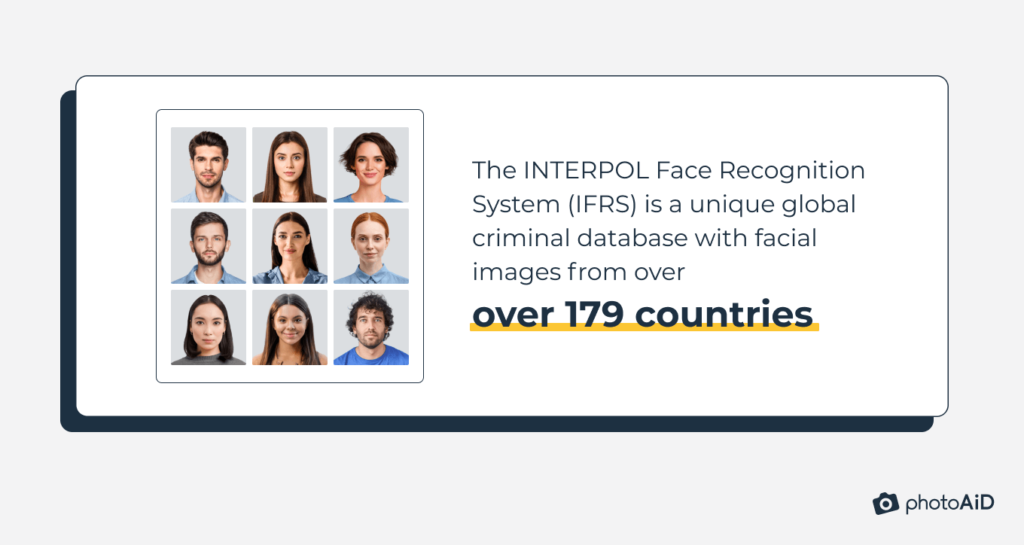
27. The INTERPOL Face Recognition System (IFRS) is a unique global criminal database with facial images from over 179 countries.
28. Seven in 10 governments use facial recognition extensively.
29. San Francisco was the first US city to ban police use of facial recognition in May 2019.
30. Roughly 60% of countries use facial recognition technology at select airports.
31. Around 20% of countries use facial recognition technology in some schools.
32. Approximately 40% of countries have adopted facial recognition in some workplaces.
Sources: CBP, Comparitech, INTERPOL, MIT Technology Review
Keep Exploring
Looking for more statistics? Check out these resources:

As a Digital PR specialist and a member of the Society of Professional Journalists (SPJ), I have 5+ years of writing experience.
Over the course of my career, my work has garnered significant attention, with features in numerous prominent publications such as The New York Times, Forbes, Inc., Business Insider, Fast Company, Entrepreneur, BBC, TechRepublic, Glassdoor, and G2.